Dental Implants
A permanent replacement for missing teeth, placed by a Penn-trained periodontist who does implant surgery every week.
Learn more
Rebuilding the jawbone so an implant has something solid to hold onto.
Jawbone exists to hold teeth. When a tooth is lost, the bone that surrounded it loses its purpose and begins to resorb — noticeably within months, and substantially over years. Gum disease, injury and long-term denture wear cause the same erosion.
That creates a problem for implants, which need adequate bone volume and density to integrate properly. Bone grafting rebuilds the deficient area, restoring a foundation strong enough to support an implant that will last.
Grafting is a routine, well-established part of implant practice rather than an exotic add-on. Dr. Liu performs these procedures using 3D imaging for planning and Piezosurgery instrumentation, which cuts bone with ultrasonic vibration while leaving nerves, membranes and soft tissue unharmed.
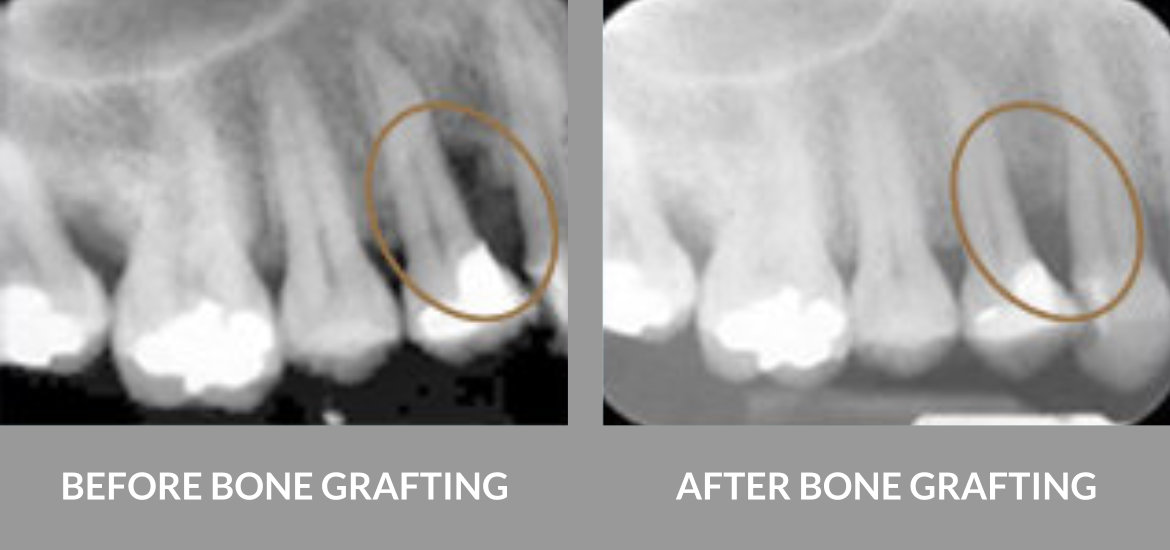
Grafting is indicated when there is not enough healthy bone to place an implant safely and predictably. Common situations include:
Whether you need a graft is determined from a 3D Cone Beam CT scan, which measures bone in three dimensions. A conventional x-ray shows height but not width, and width is frequently the limiting factor.
Grafting material is placed into the socket at the same appointment a tooth is extracted. This is the single most effective grafting procedure available, because preventing bone loss is far easier than rebuilding bone afterward. If you know a tooth is coming out and an implant may follow, ask about socket preservation before the extraction.
Where a ridge has already narrowed or flattened, augmentation rebuilds its width and height. This is the procedure used when a tooth has been missing for years.
A barrier membrane is placed over the graft so that fast-growing soft tissue cannot invade the space before slower-growing bone fills it. The membrane holds the space open for the bone to claim.
Bone defects around an existing implant caused by peri-implantitis can often be cleaned and grafted, saving an implant that would otherwise be lost.
In the upper back jaw, gaining height means working with the sinus floor — a distinct procedure covered on our sinus augmentation page.
Several material types are used, chosen to suit the defect:
All of these act primarily as a scaffold. The graft is not the finished product — it holds space and gives your own bone cells a structure to grow into, and over several months your body replaces much of it with native bone. Dr. Liu will explain which material is being proposed for your case and why.
If an extraction is being planned, call us first. Grafting the socket at the time of extraction is markedly simpler than rebuilding a collapsed ridge a year later, and it keeps your implant options open.
The procedure is performed under local anesthesia, so it is not painful as it happens. Most patients describe the recovery as comparable to having a tooth extracted — some swelling and soreness for a few days, usually well controlled with over-the-counter medication.
Larger grafts involve more discomfort than small socket grafts. Sedation is available for patients who would prefer it.
Typically four to nine months, depending on the size and type of graft. Small socket grafts are at the shorter end; large ridge augmentations at the longer.
The graft is not rushed. Placing an implant into a graft that has not fully matured is a leading cause of implant failure, so a follow-up scan confirms readiness before proceeding.
Yes. Allograft material comes from accredited tissue banks and undergoes rigorous screening, processing and sterilisation that removes all cellular and organic components — what remains is the mineral scaffold. Xenograft material is processed to the same standard.
These materials have been used in dentistry and orthopaedics for decades with a well-documented safety record. If you would prefer a particular material type, tell us and we will discuss the options for your case.
Sometimes. Shorter or narrower implants, or angling implants to use available bone, can occasionally avoid grafting. Whether that is appropriate depends entirely on your anatomy and where the final tooth needs to sit.
What we will not do is place an implant into inadequate bone to save a step. An implant without a solid foundation fails, and the failure costs more than the graft would have.
A permanent replacement for missing teeth, placed by a Penn-trained periodontist who does implant surgery every week.
Learn moreAdding bone height in the upper back jaw so implants can be placed where the sinus is in the way.
Learn moreRebuilding bone and attachment lost to gum disease, rather than simply halting the damage.
Learn moreDr. Liu will evaluate your situation and explain your options — including the ones you may not have been offered elsewhere.