Gingivitis & Periodontitis Treatment
Understanding which stage of gum disease you have — and what can still be reversed.
Learn more
Specialist care for the gum and bone that hold your teeth in place — the foundation everything else depends on.
Periodontics is the dental specialty concerned with the structures that support your teeth — the gums, the periodontal ligament and the jawbone. A periodontist completes three additional years of specialty training beyond dental school in diagnosing and treating disease in those tissues, and in placing dental implants.
Most people arrive here for one of three reasons: their dentist found deep pockets or bone loss and referred them, their gums have receded, or they need an implant placed. All three come back to the same thing — whether the foundation under the teeth is healthy enough to hold.
Dr. Steven Liu, DMD, DDS holds specialty certificates in both periodontics and prosthodontics from the University of Pennsylvania, and has taught, lectured and published internationally in the field. Patients across Berwyn, Wayne, Devon, Paoli, Villanova and the wider Main Line are treated here.
Periodontal disease is the leading cause of tooth loss in adults, and it is usually painless until it is advanced. Teeth do not typically feel loose until a substantial amount of the bone holding them has already gone — and lost bone does not grow back on its own.
The disease is also not confined to your mouth. Periodontal inflammation has been associated in the research literature with cardiovascular disease, diabetes, respiratory conditions and complications in pregnancy. Treating it is a general health matter as much as a dental one.
The practical implication is simple: gum disease is best caught early, when treatment is conservative, rather than late, when it is surgical.
From early gingivitis through advanced periodontitis. Early stages respond to non-surgical treatment; advanced cases may require surgical pocket reduction or regenerative therapy to rebuild what has been lost.
When gum tissue pulls back and exposes root surface, teeth become sensitive, look longer, and lose protection. Soft tissue grafting, including the minimally invasive Pinhole technique, restores coverage.
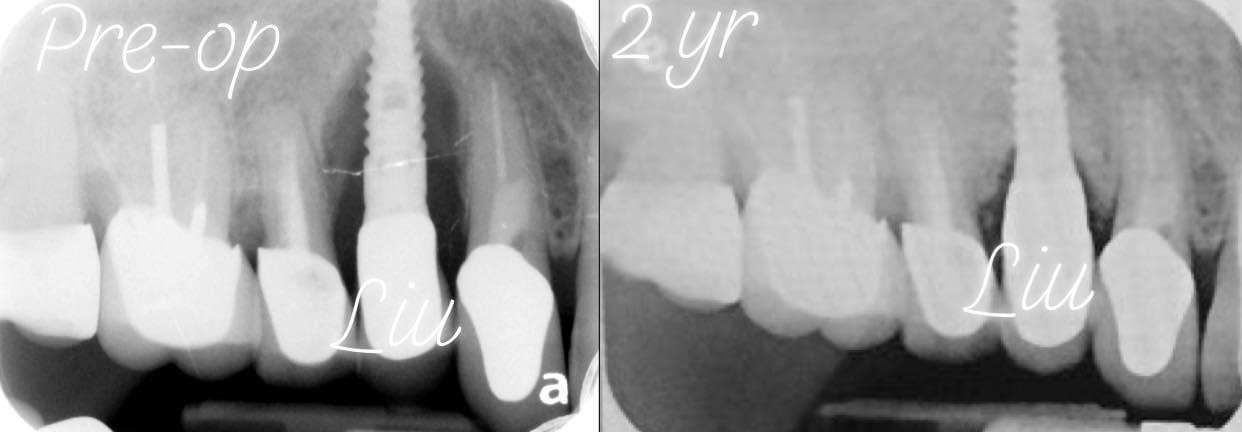
Dental implants can develop inflammation and bone loss around them, just as natural teeth can. Treating a failing implant is a specialist problem, and one Dr. Liu handles regularly — often with bone grafting to rebuild the defect around the implant.
Excessive or misdirected biting force accelerates periodontal breakdown. Where the bite is a contributing factor, occlusal therapy is part of the treatment rather than an afterthought.
Uneven gum lines and "gummy" smiles are corrected with crown lengthening. Dr. Liu's earliest published work, in Compendium of Continuing Education in Dentistry, was on the management of gingival and aesthetic problems.
Book an evaluation if you notice any of the following:
Bleeding is the one most often dismissed. Healthy gums do not bleed when brushed — bleeding is inflammation, and inflammation is the start of the process that ends in bone loss.
For referring dentists: we welcome referrals for periodontal evaluation, implant placement, grafting and complex reconstruction, and we report back at every stage. Reach the practice directly at (610) 722-5542.
A general dentist handles routine care — cleanings, fillings, crowns. A periodontist completes three years of additional specialty training focused specifically on gum and bone disease and on the surgical placement of dental implants.
You are typically referred to a periodontist when gum disease has progressed past what a routine cleaning addresses, when gum surgery or grafting is needed, or when an implant requires placement in a site that is not straightforward.
No. Many patients are referred by their general dentist, but you are welcome to book an evaluation directly. If you already have a dentist, we coordinate with them so your care stays joined up.
Gingivitis — the earliest stage, before bone is affected — is genuinely reversible with treatment and good home care.
Periodontitis is different. Once bone has been lost it does not spontaneously return, so periodontitis is controlled rather than cured. With treatment and regular maintenance the disease can be stopped and teeth kept for life. In selected defects, regenerative procedures can rebuild some of the lost bone.
Most dental plans provide some coverage for periodontal treatment, though the level varies considerably between plans. We will review your benefits with you and provide a written estimate before treatment begins.
Understanding which stage of gum disease you have — and what can still be reversed.
Learn moreDeep cleaning and antibiotic therapy — the first line of treatment for gum disease, and often the only one needed.
Learn moreWhen deep pockets cannot be cleaned any other way, surgery makes them cleanable again.
Learn moreDr. Liu will evaluate your situation and explain your options — including the ones you may not have been offered elsewhere.