Bone Grafting
Rebuilding the jawbone so an implant has something solid to hold onto.
Learn more
A permanent replacement for missing teeth, placed by a Penn-trained periodontist who does implant surgery every week.
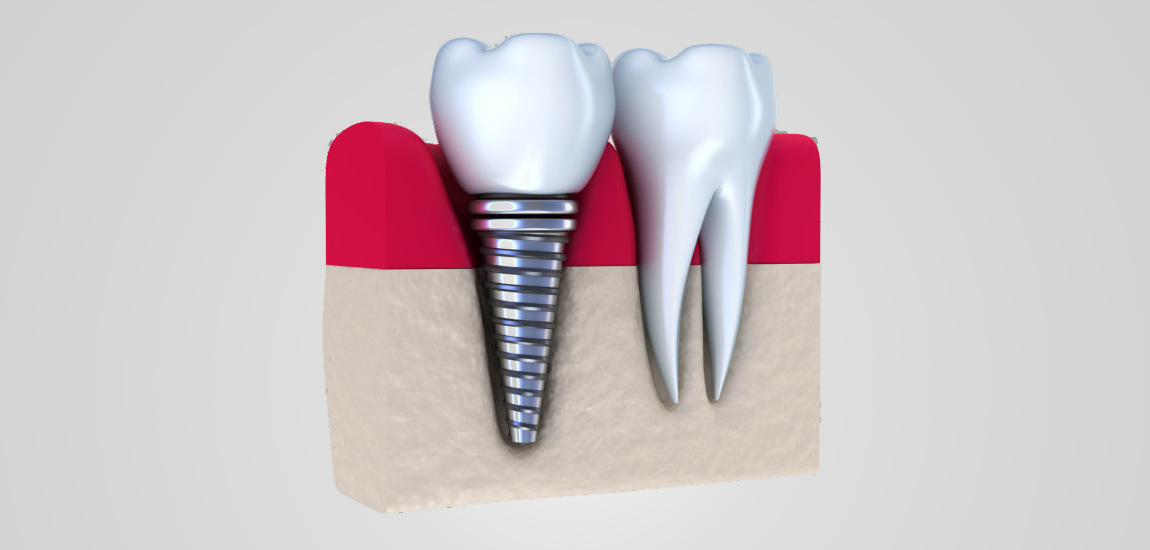
A dental implant is a small titanium post placed into the jawbone to take over the job of a missing tooth's root. Over the following months the bone grows directly onto the implant surface — a process called osseointegration — locking it in place. A crown is then attached on top, and the result looks, feels and functions like a natural tooth.
Implants are the closest thing modern dentistry has to giving a tooth back. Unlike a bridge, an implant does not require grinding down the healthy teeth on either side of the gap. Unlike a denture, it does not move, and it keeps stimulating the jawbone so the bone does not melt away over time.
At Main Line Dental Implant Center, implants are placed by Dr. Steven Liu, DMD, DDS — a periodontist with formal certificates in both periodontics and prosthodontics from the University of Pennsylvania. That dual training matters more than it sounds: the surgeon planning the implant is also trained in how the final tooth has to be restored, so the implant goes in where the crown actually needs it.
Most adults missing one tooth, several teeth, or all of their teeth are candidates. What determines success is less about age than about two things: the amount and quality of bone available, and the health of the surrounding gum tissue.
You may be a good candidate if you:
Not having enough bone is rarely a disqualifier on its own. Bone grafting and sinus augmentation are routine parts of implant practice, done specifically to build a site back up so an implant can be placed predictably.
Active gum disease does need to be treated first. An implant placed into inflamed, infected tissue is an implant at risk, which is why a periodontist evaluates gum health before anything else. If periodontal disease is present, it is brought under control before implant surgery is scheduled.
One implant, one crown. The neighboring teeth are left entirely untouched — the main advantage over a traditional three-unit bridge, which requires cutting down two healthy teeth to carry the replacement.
Two or more implants can support a fixed bridge spanning several missing teeth, without needing an implant for every single tooth.
A small number of strategically placed implants can anchor a full arch of teeth. This is the option that changes daily life most dramatically for long-time denture wearers — the prosthesis stops moving, and biting force returns much closer to normal.
In selected cases the implant can be placed at the same appointment the failing tooth is removed, which preserves bone that would otherwise resorb after extraction and reduces the total number of surgeries. Dr. Liu has published peer-reviewed work on the classification of immediate implant placement and immediate implant provisionalization; whether your case is suitable is determined from 3D imaging and the condition of the extraction site.
When many teeth are failing at once — through advanced gum disease, long-term wear, or a bite that has collapsed — the answer is rarely one implant at a time. Full-mouth reconstruction combines implants, grafting, gum treatment and bite correction into a single sequenced plan.
This is where Dr. Liu's background in periodontal prosthesis is directly relevant. Reconstructing an entire mouth requires deciding which teeth to keep, which to replace, and how the finished bite will distribute force for the next twenty years. It is planned in one go rather than assembled piecemeal.
Referred by your dentist? Many of our implant patients are referred by general dentists across the Main Line for the surgical phase, then return to their own dentist for the final restoration. We work either way, and we coordinate directly with your restorative dentist throughout.
The placement itself is done under local anesthesia and is not painful. Most patients report that implant surgery was easier than they expected — and frequently easier than having the original tooth extracted.
Afterward, some soreness and swelling for a few days is normal and is usually managed with over-the-counter pain relief. Our practice is built around keeping treatment as close to painless as possible, and sedation options are available for patients who are anxious about surgery.
For a straightforward case, expect roughly three to six months from placement to final crown. The great majority of that time is healing, not appointments — the bone needs time to fuse to the implant, and that cannot be rushed without risking the result.
Cases requiring bone grafting or a sinus lift take longer, since the graft must mature before the implant goes in. Immediate placement cases can be considerably shorter. Dr. Liu will give you a realistic timeline for your specific situation at the consultation.
Cost depends on how many implants are needed, whether grafting is required, and the type of final restoration. Because those variables differ so much between patients, a meaningful number can only come from an actual examination.
We provide a written treatment plan with costs before you commit to anything. Many dental plans contribute toward part of implant treatment, and we will help you understand what your plan covers. Call (610) 722-5542 to arrange a consultation.
Implants are intended as a permanent solution and frequently remain in service for decades. The implant itself is titanium and does not decay.
What determines longevity is the health of the gum and bone around it. Implants can develop peri-implantitis — an inflammatory condition comparable to gum disease — if plaque is allowed to accumulate. Regular hygiene and periodontal maintenance visits are what protect the investment. The crown on top may need replacement at some point, which is a much smaller matter than replacing the implant.
There is no upper age limit. Bone quality and general health matter; date of birth does not. We routinely treat patients in their seventies and eighties who go on to eat comfortably for the first time in years.
Rebuilding the jawbone so an implant has something solid to hold onto.
Learn moreAdding bone height in the upper back jaw so implants can be placed where the sinus is in the way.
Learn moreUnderstanding which stage of gum disease you have — and what can still be reversed.
Learn moreDr. Liu will evaluate your situation and explain your options — including the ones you may not have been offered elsewhere.