Bone Grafting
Rebuilding the jawbone so an implant has something solid to hold onto.
Learn more
Adding bone height in the upper back jaw so implants can be placed where the sinus is in the way.
The maxillary sinuses are air-filled spaces sitting directly above the roots of your upper back teeth. In many people the floor of the sinus sits low, leaving only a thin shelf of bone between the mouth and the sinus cavity — sometimes just a few millimetres.
That is not a problem until you need an implant there. Implants require adequate bone height, and the upper back jaw is the most common site in the mouth to fall short of it — both because sinuses vary naturally in size and because this region resorbs quickly once molars are lost.
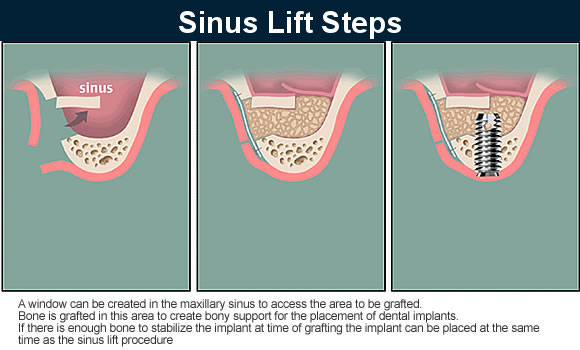
A sinus augmentation, commonly called a sinus lift, gently raises the sinus membrane and places bone graft material in the space created. Once that bone matures, there is enough height to place an implant securely.
Dr. Liu plans every sinus case from a 3D Cone Beam CT scan, which shows the sinus anatomy, any septa within it, and the precise bone height available at each site. This is not a procedure to attempt from a 2D x-ray.
Three factors combine to make this region the hardest place in the mouth to place an implant:
This combination is why patients are frequently told elsewhere that they "don't have enough bone" for upper back implants. In most cases they do not have enough bone yet — which is a different statement.
A small access window is made in the side wall of the sinus. The membrane lining the sinus is carefully lifted upward and graft material placed beneath it. This is the approach used when a substantial gain in height is required.
Piezosurgery is particularly valuable here: ultrasonic instruments cut bone but do not cut soft tissue, which markedly reduces the risk of perforating the delicate sinus membrane during access.
Where only a modest gain is needed and reasonable bone already exists, the sinus floor can be raised through the implant site itself — no side window. Less invasive, with a quicker recovery, but only suitable when the starting bone height allows it.
In some crestal cases the implant can be placed at the same appointment as the lift, collapsing two procedures into one. Whether that is possible depends on achieving adequate initial stability for the implant.
Recovery is generally more comfortable than patients anticipate. Expect swelling for several days and some minor bleeding from the nose.
Specific post-operative instructions matter more here than in most procedures, because pressure changes can disturb a healing graft. For a defined period afterward you will be asked to:
These are given to you in writing, and following them closely is a genuine factor in whether the graft succeeds.
Told you don't have enough bone for an upper implant? That is frequently the starting point for a sinus augmentation rather than the end of the conversation. A 3D scan will establish what is actually possible.
It is a well-established procedure with a long track record. The main risk is perforation of the sinus membrane, which is why planning from a 3D scan and using Piezosurgery instrumentation matter — small perforations that do occur can usually be repaired during the same procedure.
Sinus infection is an uncommon complication and is treatable. Dr. Liu will review the specific risks for your anatomy at the consultation.
No. The procedure raises the floor of the sinus slightly and reduces its volume marginally. It does not interfere with sinus drainage or with normal breathing.
Patients with existing chronic sinus conditions should mention them, as those may need managing before surgery.
Usually six to nine months for a lateral window graft to mature sufficiently. Crestal lifts with simultaneous implant placement obviously avoid the wait, but require enough starting bone to be an option.
A follow-up scan confirms the graft is ready — the timeline is guided by what the bone actually shows, not by the calendar alone.
Sometimes. Shorter implants, tilted implants placed to use available bone, or implants positioned further forward can avoid the sinus in selected cases.
Whether any of those apply depends on your anatomy and on where the replacement teeth need to sit to function properly. A consultation with 3D imaging is what answers it.
Rebuilding the jawbone so an implant has something solid to hold onto.
Learn moreA permanent replacement for missing teeth, placed by a Penn-trained periodontist who does implant surgery every week.
Learn moreRebuilding bone and attachment lost to gum disease, rather than simply halting the damage.
Learn moreDr. Liu will evaluate your situation and explain your options — including the ones you may not have been offered elsewhere.