Gum Grafting & Soft Tissue Grafts
Covering exposed roots and rebuilding a gumline that has receded — including options with no scalpel and no sutures.
Learn more
Reshaping gum and bone to expose more tooth — either to fix a gummy smile or to give your dentist enough tooth to restore.
Crown lengthening reshapes the gum tissue and, where necessary, the bone underneath, to expose more of the natural tooth. It is performed for two quite different reasons — one aesthetic, one structural — using the same underlying technique.
Aesthetically, it corrects a "gummy smile": teeth that look short or small because too much gum covers them. The teeth are usually the right size all along; they are simply hidden.
Restoratively, it gives your dentist enough sound tooth structure to work with when a tooth has fractured or decayed at or below the gumline. Without it, a crown placed on insufficient structure has nothing reliable to grip and tends to fail.
Dr. Liu performs crown lengthening using Piezosurgery — ultrasonic instrumentation that cuts bone precisely while leaving gum tissue unharmed. His first peer-reviewed publication, in Compendium of Continuing Education in Dentistry, addressed the management of gingival and aesthetic problems.
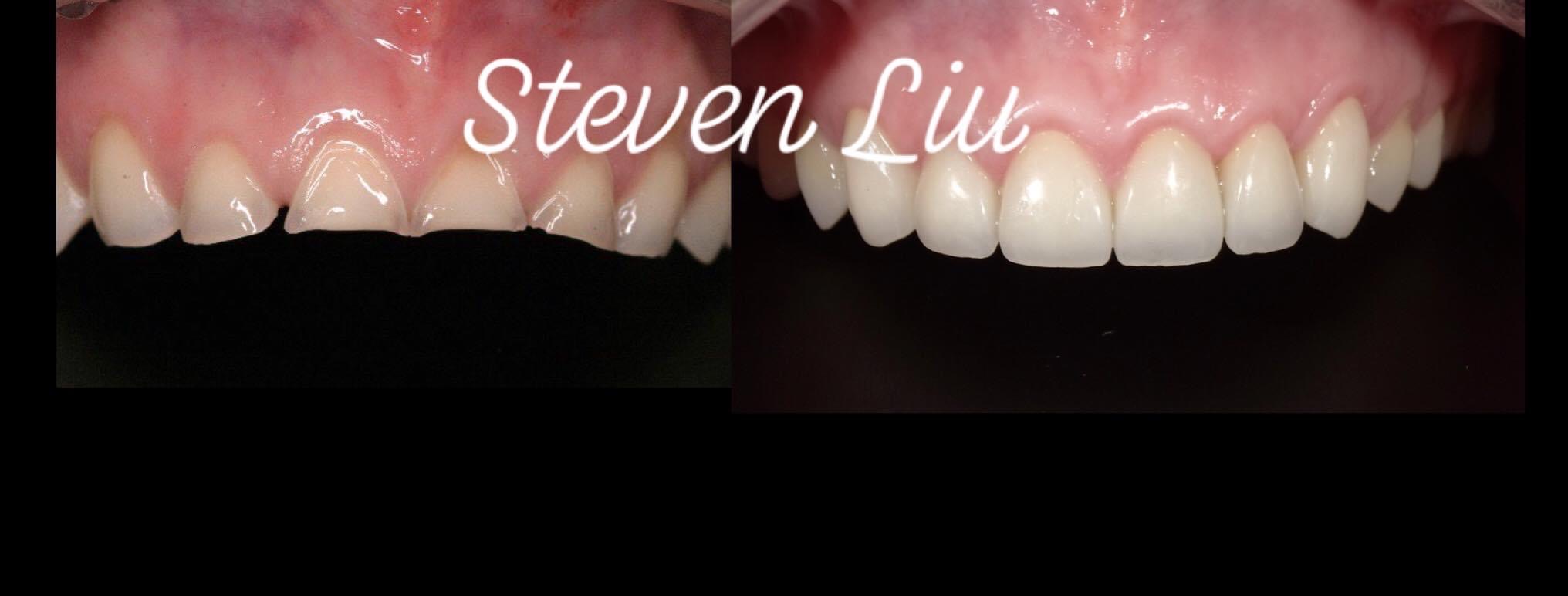
If your smile shows a lot of gum, or your teeth look short, square or uneven, the issue is usually gum position rather than tooth size. Aesthetic crown lengthening removes excess gum tissue — and recontours the bone beneath it, which is the part that makes the result stable rather than temporary.
It is a comparatively small procedure with a disproportionate effect on how a smile reads. Common reasons patients seek it:
Where the gum line is being reshaped ahead of restorative work, we coordinate directly with your restorative dentist so the finished result is planned as one outcome rather than two separate procedures.
Teeth that have fractured at the gumline, decayed beneath it, or been worn down over years frequently do not present enough structure above the gum for a crown to hold. Cementing a crown onto inadequate structure produces a restoration that loosens, leaks and eventually fails.
Functional crown lengthening exposes additional healthy tooth so your dentist has a proper margin to work against. It commonly precedes:
Frequently this is the procedure that lets a tooth be saved rather than extracted — which is the outcome worth weighing it against.
Gum tissue takes several weeks to settle into its final position and several months to fully mature. For that reason, permanent restorations are usually placed after an appropriate healing interval rather than immediately — placing a final crown against a gum line still in motion means the margin ends up in the wrong place.
Temporary restorations can be worn in the interim so you are never walking around with an unfinished front tooth.
Been told a tooth "can't be crowned"? Insufficient tooth structure above the gum is a common reason, and it is often solvable with crown lengthening. It is worth a second opinion before agreeing to an extraction.
The surface heals within a couple of weeks, but the tissue continues settling into its final position for roughly three months.
For front teeth, final restorations are usually delayed until that settling is complete, so the crown margin ends up exactly where it should be. Back teeth can often be restored sooner. Temporaries are used meanwhile.
Some temporary sensitivity to cold is common, since a portion of tooth that was previously covered is now exposed. It typically settles within a few weeks.
Desensitising toothpaste helps in the interim. Persistent sensitivity is uncommon and should be reported so we can address it.
Functional crown lengthening performed to enable a restoration is often covered at least in part, since it is medically necessary to save the tooth. Purely aesthetic crown lengthening is generally treated as a cosmetic procedure and is less likely to be covered.
We will review your specific benefits and give you a written estimate before treatment.
Depending on the underlying cause, alternatives can include orthodontic treatment, lip repositioning, or in some cases treatment addressing jaw position. A gummy smile caused by excess gum tissue responds well to crown lengthening; one caused by skeletal proportion may not.
Determining which you have is the point of the consultation — the treatment follows from the diagnosis, not the other way round.
Covering exposed roots and rebuilding a gumline that has receded — including options with no scalpel and no sutures.
Learn moreSpecialist care for the gum and bone that hold your teeth in place — the foundation everything else depends on.
Learn morePreparing gum tissue before braces, so orthodontic movement does not cause recession.
Learn moreDr. Liu will evaluate your situation and explain your options — including the ones you may not have been offered elsewhere.