Periodontics
Specialist care for the gum and bone that hold your teeth in place — the foundation everything else depends on.
Learn more
Correcting how your teeth meet, so biting force stops destroying what has been restored.
Occlusion is simply how your upper and lower teeth meet. When that relationship is off — or when grinding and clenching generate forces far beyond normal chewing — teeth crack, restorations fail, gums recede and the bone supporting teeth breaks down faster than it otherwise would.
This is the part of dentistry most often left out of a treatment plan, and it is frequently the reason work does not last. A crown that keeps fracturing, an implant that loosens, recession that returns after grafting: all can trace back to a bite problem that was never addressed.
Dr. Liu's training in both periodontics and prosthodontics puts occlusion at the centre of how treatment is planned here. He has published peer-reviewed work on occlusal adjustment techniques for preventing open proximal contacts, and on the role of bite forces in periodontal prosthesis.
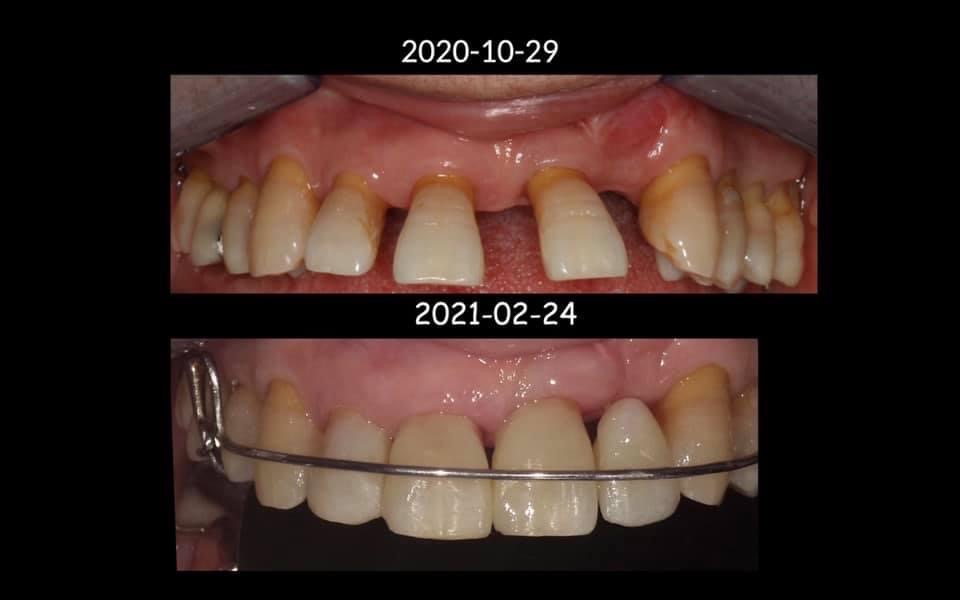
Occlusal problems are frequently silent until damage shows. Worth investigating if you notice:
That last one is a specific interest of Dr. Liu's — open contacts between teeth, where food traps repeatedly, are frequently occlusal in origin rather than simply a restoration problem, and he has published a review on the subject.
Many people grind or clench their teeth without knowing it, most often during sleep. The forces involved substantially exceed normal chewing force and are applied for hours.
The consequences accumulate quietly: enamel wears flat, teeth become sensitive as dentine is exposed, restorations fracture, and the periodontal ligament is stressed in ways that accelerate bone loss where gum disease is also present.
Grinding is not something you can simply decide to stop, because it happens while you are asleep. What can be done is protecting the teeth from the force and reducing the trigger where possible.
Precise, conservative reshaping of specific contact points so force distributes evenly across the arch rather than concentrating on a few teeth. Done carefully and in small increments — this is not about grinding teeth down.
A custom appliance worn during sleep absorbs grinding force and protects both teeth and restorations. Custom-made guards fit properly and are worn; over-the-counter boil-and-bite versions typically are not.
A therapeutic appliance used to reposition the jaw and let overworked muscles settle. Often used diagnostically — how symptoms respond helps confirm whether the bite is genuinely the cause before any irreversible treatment is considered.
Where teeth have already worn significantly or are missing, restoring correct height and contact may require crowns, implants or a coordinated full-mouth reconstruction. This is planned around the finished bite rather than tooth by tooth.
Restorations that keep failing are a symptom. If crowns or fillings on the same tooth have needed repeated repair, the bite is worth examining before another one is placed.
Most people do not know until someone tells them or a dentist spots the wear. Common indicators are waking with a sore jaw or dull headache, teeth that feel sensitive in the morning, flattened biting surfaces, and a partner reporting the sound.
Wear patterns are quite specific and readily identified on examination.
Generally yes. A custom guard is made to your teeth, fits accurately, and is adjusted so it does not itself introduce a new bite problem. An ill-fitting appliance can shift teeth or aggravate the joint.
The practical difference is that custom guards get worn every night, and over-the-counter ones tend to end up in a drawer.
Reshaping tooth surfaces is irreversible, which is precisely why it is approached conservatively and only after reversible options have clarified the diagnosis. Adjustments are made in small increments and reassessed.
If your bite problem can be managed with an appliance alone, that is the preferred route.
Excessive occlusal force does not cause periodontal disease on its own — bacteria do that. But where periodontal disease is already present, heavy or misdirected force can accelerate the breakdown of the supporting bone.
This is why the bite is assessed as part of periodontal treatment here, not treated as a separate matter.
Specialist care for the gum and bone that hold your teeth in place — the foundation everything else depends on.
Learn moreA permanent replacement for missing teeth, placed by a Penn-trained periodontist who does implant surgery every week.
Learn moreWhen deep pockets cannot be cleaned any other way, surgery makes them cleanable again.
Learn moreDr. Liu will evaluate your situation and explain your options — including the ones you may not have been offered elsewhere.