Non-Surgical Gum Treatments
Deep cleaning and antibiotic therapy — the first line of treatment for gum disease, and often the only one needed.
Learn more
When deep pockets cannot be cleaned any other way, surgery makes them cleanable again.
Gum surgery is recommended when non-surgical treatment has been carried out properly and pockets remain deep. It is a second step, not a first resort — every patient here is treated non-surgically first and re-measured before surgery is considered.
The reasoning is mechanical. Instruments used blind below the gumline are effective to a limited depth. Beyond roughly five millimetres, thorough cleaning of a root surface without seeing it becomes unreliable, particularly where roots branch or curve. Deposits left behind keep the disease active, and bone continues to be lost.
Surgery solves this by providing direct vision and access. Deposits are removed under sight rather than by feel, irregular bone is recontoured, and the tissue is repositioned so the resulting pocket is shallow enough that you can keep it clean yourself.
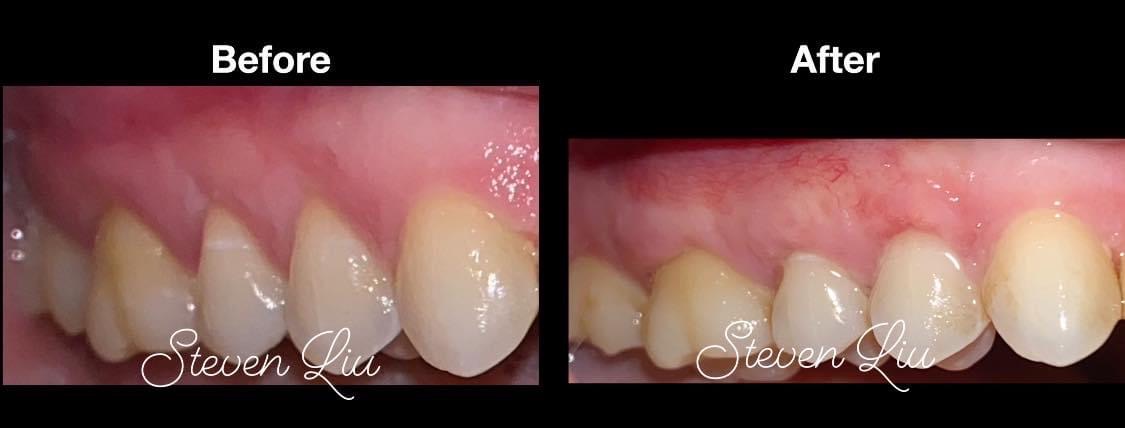
This is the most common form of periodontal surgery. Under local anesthesia, the gum tissue is gently reflected away from the teeth to expose the root surfaces and the bone.
With direct vision — using magnification and fibre-optic illumination — plaque and calculus adhering to the roots are removed thoroughly. Where periodontal disease has left the bone with irregular, crater-like contours that trap bacteria, the bone is recontoured to a smoother, more cleanable shape.
The gum tissue is then repositioned closely around the teeth and sutured. As it heals it reattaches at a lower level, leaving a shallower pocket that a toothbrush and floss can actually reach.
The success of this procedure is documented by re-measuring four to six weeks after treatment. Surgery that is not re-measured is surgery whose outcome nobody actually knows.
Where the bone contour is acceptable but deposits are inaccessible, access flap surgery provides visibility without bone recontouring.
Where the bone defect has a contained shape, the goal shifts from reduction to rebuilding. Grafts, membranes and biologic agents are used to regenerate lost tissue — see regenerative therapy.
The same surgical principles applied for restorative or aesthetic reasons rather than for disease control — see crown lengthening.
Implants affected by peri-implantitis often require surgical access to decontaminate the implant surface and graft the surrounding bone defect. Frequently this saves an implant that would otherwise be lost.
Most patients find recovery considerably easier than anticipated. Typical experience:
That last point is worth setting expectations on: after successful pocket reduction, teeth often look a little longer. The tissue that previously covered more of the tooth was inflamed and detached, not healthy.
Surgery is never the first step here. Non-surgical treatment is completed and re-measured first. Many patients who are told they need gum surgery turn out not to, once conservative treatment has been given a proper chance.
The procedure is performed under local anesthesia and is not painful as it happens. Sedation is available for patients who are anxious.
Afterward, most patients report soreness and swelling for a few days, generally well managed with over-the-counter pain relief. The great majority describe it as easier than they expected.
Most people return to work within a day or two. Soft foods for about a week, and normal brushing at the site resumes gradually over two to four weeks.
Complete tissue healing takes several weeks, with final results assessed at re-measurement a few weeks after that.
Often, slightly — and this is the intended result rather than a side effect. The tissue that previously covered more of the tooth was swollen and detached, not healthy attached gum.
Reducing the pocket means the gum sits at a healthier, lower level. In aesthetically sensitive front teeth, this is discussed and planned for in advance, and alternative approaches may be considered.
Sometimes, and it is always worth trying. Thorough non-surgical treatment combined with genuinely excellent home care resolves many cases, which is why we always complete and re-measure that phase first.
What cannot be avoided is the consequence of leaving deep pockets untreated — they continue to lose bone, and the eventual outcome is tooth loss. Declining surgery is a decision to accept that trajectory, so it is worth making with the facts in front of you.
Deep cleaning and antibiotic therapy — the first line of treatment for gum disease, and often the only one needed.
Learn moreRebuilding bone and attachment lost to gum disease, rather than simply halting the damage.
Learn moreUnderstanding which stage of gum disease you have — and what can still be reversed.
Learn moreDr. Liu will evaluate your situation and explain your options — including the ones you may not have been offered elsewhere.