Gingivitis & Periodontitis Treatment
Understanding which stage of gum disease you have — and what can still be reversed.
Learn more
Deep cleaning and antibiotic therapy — the first line of treatment for gum disease, and often the only one needed.
Not all gum disease needs surgery. For early and moderate periodontitis, non-surgical treatment is frequently sufficient to arrest the disease, and it is always where treatment begins.
The principle is straightforward: periodontal disease is driven by bacteria living in hardened deposits on root surfaces below the gumline. A routine cleaning cannot reach them. Remove those deposits thoroughly, and inflammation resolves, pockets shrink, and the disease stops advancing.
How well this works depends heavily on how thoroughly it is done and on what happens afterward. It is done here under local anesthesia, over adequate appointment time, with the result measured rather than assumed.
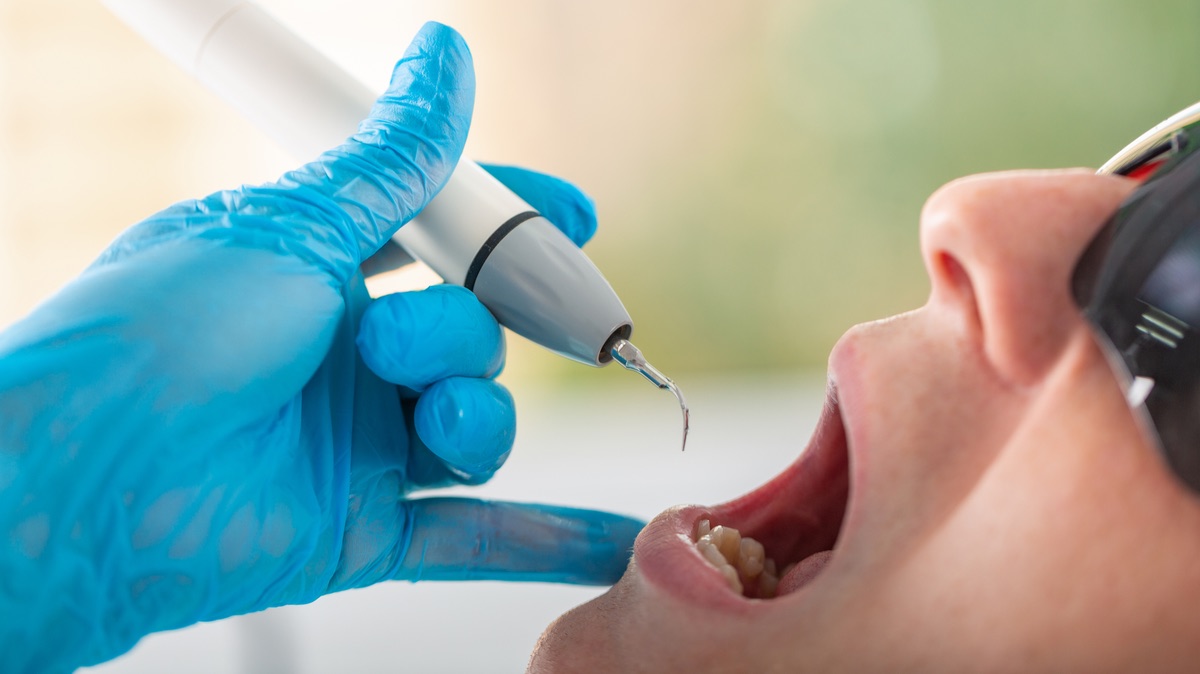
Commonly called a deep cleaning, this is the core of non-surgical periodontal treatment and it differs from a routine cleaning in both depth and purpose.
Scaling removes plaque and calculus from the tooth and root surface below the gumline — the areas a standard cleaning does not reach. Root planing then smooths the root surface, so bacteria have less to adhere to and the gum can reattach against it.
It is performed under local anesthesia, usually across two to four appointments treating one section of the mouth at a time. Ultrasonic instrumentation is combined with hand instruments — ultrasonics disrupt deposits and flush the pocket efficiently, hand instruments finish the surface.
Afterward it is normal for teeth to feel sensitive for a week or two and for gums to feel tender. Some recession may become apparent as inflammation resolves and swollen tissue shrinks back — the tissue was swollen, not attached.
Arestin is a locally applied antibiotic — minocycline in microsphere form — placed directly into a periodontal pocket immediately after scaling and root planing. It releases gradually over a period of days, targeting bacteria at the specific site.
The advantage over antibiotic tablets is concentration and containment: a high dose reaches exactly the pocket that needs it, without a systemic dose throughout the body.
It is used selectively, at sites that remain deep after deep cleaning, rather than routinely everywhere. Antibiotics should be used where there is a clear indication and a defined goal, not as a default.
Other adjuncts used where indicated include Periostat, which works by interfering with the enzyme that breaks down connective tissue, and antimicrobial rinses.
This is the step that determines whether treatment holds, and the one most often underestimated.
Once disease is controlled, periodontal maintenance visits — typically every three to four months rather than every six — remove the bacterial recolonisation that begins immediately after treatment. Research consistently shows that patients who attend regular maintenance retain their teeth at far higher rates than those who do not, regardless of how successful the initial treatment was.
Each maintenance visit includes re-measuring pocket depths, so any site that is deteriorating is caught early — while it is still a small problem.
Periodontal disease is a chronic condition. Treating it once and returning to twice-yearly cleanings reliably leads to relapse.
Not the same as a regular cleaning. If your dentist has recommended "a deep cleaning," that is scaling and root planing — a periodontal treatment measured against baseline charting, not a longer version of a hygiene visit.
It is performed under local anesthesia, so the procedure itself is comfortable. Afterward, expect tenderness in the gums and some sensitivity to cold for one to two weeks.
Sensitivity usually settles as the gum tissue heals and firms up. Desensitising toothpaste helps in the interim, and persistent sensitivity can be treated.
A routine cleaning removes deposits from the crown of the tooth and just below the gum margin. It is a preventive procedure for healthy gums.
When pockets have deepened, deposits sit on root surfaces several millimetres below the gum, out of reach of a routine cleaning. Scaling and root planing is a treatment for existing disease rather than prevention, and it is measured against baseline charting to confirm it worked.
Typically every three to four months, at least initially. That interval is not arbitrary — the bacteria associated with periodontal disease recolonise pockets within roughly that window.
Some patients with stable results and excellent home care can extend the interval over time. Those with risk factors such as smoking or diabetes generally should not.
The re-evaluation appointment is specifically designed to answer that. Sites that remain deep or continue bleeding after adequate healing are not responding, and that is useful information rather than a failure.
Options at that point include repeat instrumentation at specific sites, locally applied antibiotics, or surgical access where deposits cannot be reached without it. Deep pockets that cannot be cleaned continue to lose bone, so leaving them untreated is not a neutral choice.
Understanding which stage of gum disease you have — and what can still be reversed.
Learn moreWhen deep pockets cannot be cleaned any other way, surgery makes them cleanable again.
Learn moreSpecialist care for the gum and bone that hold your teeth in place — the foundation everything else depends on.
Learn moreDr. Liu will evaluate your situation and explain your options — including the ones you may not have been offered elsewhere.